Consensus (2025-present) was first developed in response to an invitation from Rin Peisert, Curator of Relative Intensity Noise, and Cynthia Post Hunt, Curator of Performance at the Momentary and Crystal Bridges Museum of American Art in Bentonville. This essay was written shortly before Consensus was installed for a second time as part of Matrixed Systems, a group exhibition at GLO Modern in New York organized by Danielle Paterson, Curator at Metalabel. It documented events within the gallery 24/7 from May 29 to June 29, 2026 and subsequently proposed a new account of the preceding month each day until the show closed on July 31. All records to date continue to regenerate weekly on ourconsensus.org.

1.
I remember October 2025 as unexpectedly warm. The sun shone directly onto a flat landscape of asphalt, sidewalks, and well-groomed corporate campuses none of us were allowed to enter. At night glistening streams of visitors flowed through the museum’s arteries, where both designated galleries and peripheral spaces were illuminated in the slippery palette of dreams. Rooms seized into thrashing images and sounds and bodies before quieting and eventually alighting once more. Nothing stayed fixed. Nothing made much sense. “What is going on???” a man asked his friend in genuine bewilderment, nonetheless smiling. Sometimes it was too loud and sometimes viewers felt themselves called to transgress and sometimes things happened which cannot be planned or sought or permitted. No one knew what came next.

This is only what I remember. Of course I must be wrong in so many ways, but who is to say? I can recall the thrill and terror of the hours that unfurled, reference photos holding arbitrary moments in a permanent blink, shape words into pixels on a screen that might evoke strained glimpses into irretrievable days. These are all so completely inadequate, yet these representations are the only things I can conjure for myself, for you. How strange it is to live in a world where so much can only be known through the mutilated fragments that remain.
2.
I have been increasingly bored by the contorted neatness of it all, this totalizing expectation that both our selves and productive outputs should be succinctly legible. We internalize the prevailing visual and linguistic grammars of discernment, taste, and prestige. Do any of us enjoy offering ourselves to the world as a collection of images, a carefully crafted bio, a CV outlining in brief all of our most illustrious affiliations without the moments of presence yawning behind each line? Can an artwork, a place, a promise be actually appraised through detached photos and descriptions, even the most elegant and comprehensive and faithful? More and more I am convinced not. I find myself craving the vertigo of traversing sites unnamed, starting down detours wholly unmapped, sitting with what might never recur.
We invest in our own symbolic value within economies where arbiters process these functional abstractions first, with the illusory surface as the primary unit assessed and transacted. This peculiar condition has been articulated elsewhere (Debord’s spectacle, Baudrillard and Berardi on semiocapitalism), and it will be pedantic for me to recapitulate these texts incompletely here. Today it is hard not to notice how all the stand-ins and proxies we tolerate as sufficient are in truth stripped and alienated, how they nonetheless accrue at scale through countless quiet processes beyond our perceptible grasp, reinforcing, escalating, settling. The algorithm serves you a video so baffling that you linger upon it before deciding that you never want to see anything like that ever again, but those confused seconds are understood as affirmative. The video multiplies; its creators invest real labor and resources into something no one needs, but how consequential is that initial vexed pause. The statistical representations of you, your interests, your activity, and everything in the world around you continuously accentuate and simplify. Sometimes there is no obvious error until a collision of presumptions.

The specter of “artificial intelligence” looms over this, both in its ongoing assignment to transform every iota of the cosmos into orderly units and in its own rhetorical blurring into an unmoored notion attributed impossible combinations of faults and wishes. In spite of the feverish din coming out of Silicon Valley there is no mystical power attributable to artificial intelligence. There are a lot of smart people–almost all men, White or Asian, below the age of forty, with degrees from a small set of universities–who have developed useful sequences of multiplication and addition through access to very large computers. There are so many numbers and so many steps that these researchers and engineers cannot explain or control every inference and outcome. What gets multiplied and added to, by how much, is derived from a process that repeatedly tests different adjustments following provided examples. I am describing neural network training this way not to be dismissive but to attempt, as much as possible, to step away from all the big words that carry the sheen of technical magic.
I do not deny that trillions of numbers on immense computers can do very impressive things, exceeding explicit prescription, with emergent properties that induce shock and awe. But all the embedding vectors and chained predictions and agentic workflows ultimately seep into the backrooms of everyday life, confronting the same entropic universe constantly besieging our best laid plans. The understructure of the operational image–which can still be parsed by the human eye–is the numeric matrix produced and consumed by contemporary machine learning models. We see a meaningless grid of decimals. The algorithm might see a person and all that usefully distinguishes their self and psyche from another. It can be astonishingly good at ascertaining your most obvious differentiators. I would hope though that you have secrets which cannot be so pithily captured by 3,072 characters, figures, anything.
Manufacturers promote seductive fantasies of paradigm-changing advances. The public shifts its expectation of what can be predicted, represented, and created. Debates roar with the heat of allegiances, incentives, ideologies, fears, the desire to assert oneself influential and authoritative. Capital recklessly deploys new, promising tools to varying success. What exactly is the thing itself? Whose generalizations are correct? Which future is most likely?
I won't claim some definitive answer. Let me just show you one thing.
3.

Concretely, here is what happened. A friend invited me to contribute an artwork to a durational program of time-based art. I set up webcams in the corners of two rooms joined by an exterior bridge. I placed large screens in two locations, outside and internal to these now watched spaces. A third screen was placed in the museum lobby, providing visitors a portal to dislocated scenes somewhere in the distant cavities of the building to be discovered. A fourth screen was available on anyone’s cell phone, laptop, desktop, further obstructed by a continuous stream of half-coherent text narrating the activities on view. Once the performances and activations commenced, each of these screens would begin broadcasting both live video and incrementally mediating narrations generated by two open-source models. One attempted to describe what was happening. The other attempted to estimate how many people were present, which the system used as a heuristic for attention and thus importance. Every few seconds the system processed events across the museum. Thousands of observations were noted; exactly 2,542 were ultimately deemed significant according to human presence. These 2,542 sentence fragments informed a final summary upon conclusion asserting what supposedly occurred, rendered on a website now abruptly sparse with the clinical appearance of undecorated fact. Every week this account automatically re-generated, combing the same finite stubs, a futile exercise towards severed truths. Each view on-site vs online, during vs after, offered a slight formal shift corresponding to the procession of abbreviation and loss.
Running any software involving machine learning in real time, on real inputs, can be difficult. There are the inevitable bugs that come with any collection of code, exacerbated by the severe handicap suffered by even the most optimized models – training and evaluation data remain a tiny slice of reality, so every model in the wild will encounter unseen sights, sounds, words. Those accustomed to routine intimacies with their chatbot of choice associate “AI” with its most pleasing form nourished by energy-intensive servers whose real cost remains untenably, optimistically discounted. But the automated apparatuses tightly latticed upon contemporary economic and social life cannot afford to wait luxurious minutes for each judgment, each prediction, each of the virtually innumerable operations happening above us, below us, within plastic exteriors and tactile interfaces and distant walls, in our very palms. In many cases models must be fast to be useful. The faster the model is, the more it must make an epistemic bargain: that its compressed world allows it to navigate vast, unruly expanses adequately enough, at least in the scenarios it has been designed for, the only slivers of encounter that matter. It was important for me that these are models which already existed, not sleek contrivances for this artwork but readymades embodying aims and decisions from the world at large. The models I used are good in theory, but in practice they have never been trialed on anything resembling what they were tasked with here. They are built for industry, for utility, for the academic or professional advancement of their creators. Regardless they were released for anyone to use, generously offered to corporations and governments and researchers and even an individual artist dragging these tidy artifacts far, far out of bounds.

I had no idea what would happen. I was nervous that my hardware would fail, the application would hit a bug, the wifi would go down, the models would blurt out nonsense after nonsense beyond aesthetic or semantic interest. This artwork is predicated upon representation as self-evidently inadequate, but I had no ability to anticipate what inadequacies would emerge. Over and over the system regurgitated its oneiric setting with a sort of disassociated myopia, noting the literal shapes and terms of people and objects mostly correctly, trembling more and more as it veered into conjecture. Is this a museum or a warehouse or a post office? Is there fog or fire or cloud? To everyone’s surprise the system repeatedly demonstrated two oddly specific subjectivities. It liked to call some people “my friend.” It also judged multiple viewers as “too old.” At times tender, at times cruel, so often half-right and yet so wrong. Just like us.

4.
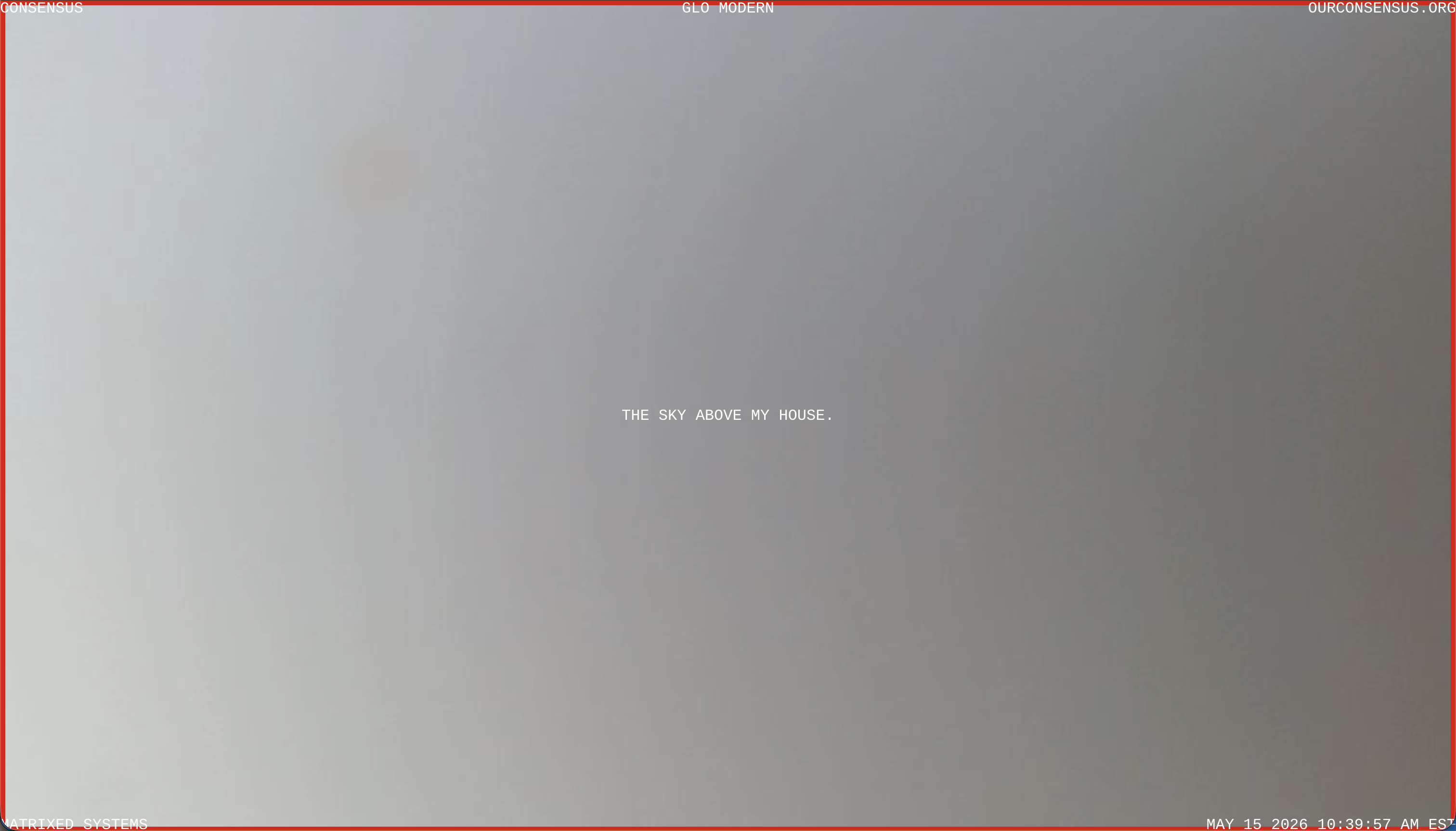
Aspirationally, here is what will happen. Consensus has been installed for a second time in a different setting. It will attempt to document an exhibition in a single-room gallery for one month. Around the clock it will beam out a poor view of the activities within onto Market St in the Two Bridges neighborhood of Manhattan. A more noisy view can once again be accessed online, dominated by ceaseless interpretations above stuttering images faintly visible in the gaps and margins. Much of the time there will be no activity. The system will dutifully continue its assigned labor, describing what it sees rotely. At one point during install the camera was obstructed, facing only a wash of gray. The sky above my house, it repeated, again and again. The camera's vantage might be frequently disturbed—obstructed, dislodged, subject to the whims of electricity and internet—all unintended, all still facts. A record will emerge, unquestioning, earnest, an undiscerning pantomime of how we distill infinity into discrete, tractable units. What will the system consider noteworthy? What mimicries will it adopt? What inventions might calcify into plausible truth? I’m glad to not know.
X. A. Li is a Chinese-American artist and computer scientist living in Chicago. She creates volatile environments that escalate systems of logic into nonsense. Drawing from an embedded background in "artificial intelligence" research, she uses video, sound, text, and code to construct installations and performances that misappropriate ordinary economic and technical protocols beyond familiar utility. Materialized through indeterminate conditions unfolding across space and duration, her work agitates default notions of the correct and inevitable, seeking the unknown. She holds an M.S. in Computer Science from the Georgia Institute of Technology and a B.A. in Economics from the University of Chicago.